
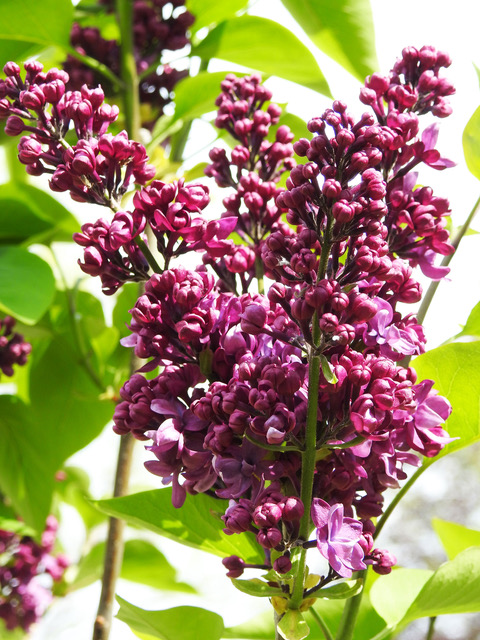

My horticultural memory is crowded with lilacs. Growing up in the Jordan neighborhood, nearly every yard had at least one lilac bush or tree, many with several grown together into a hedge along the lot line or alley. On Mother’s Day many a mom received a fistful of branches covered with blooms of various shades of lavender and with that unforgettable sweet aroma; the plants conveniently bloom in early May. The “new” superhighway 100, the beltway of the city, had lilacs planted along most of its western and northern sections earning it the name the “Lilac Way,” and Golden Valley began to celebrate “ Lilac Days.”
Our first two homes in the Webber-Camden neighborhood had a lilac hedge on the lot lines and our current home in Victory came with two large lilac trees on the east side. My dismay over their measly yield of blooms led me to research the reasons, and that ultimately led me into the Master Gardner program.
Lilacs range in size from the Japanese Tree Lilac (Syringa reticulata), which can grow to more than 25’ in height, to the smaller bushes Meyer Lilac ( Syringa meyeri) and the Miss Kim Lilac (Syringa patula ‘Miss Kim’) that generally are between 5’ and 8’ at maturity. What we used to see the most of in our urban gardens is the Common Lilac (Syringa vulgaris) which along with the Chinese Lilac (Syringa x chinensis) and the Late Lilac (Syringa villosa) are usually 8’-15’ tall. As you can probably tell, the genus for lilacs is Syringa, from the Greek word syrinx, meaning pipe or tube. Lilac stems can be hollowed out.
The lilac is actually a member of the olive (Oleacae) family and is native to Asia and southeastern Europe. The word lilac has its root in the Persian word ‘nilak,’ meaning bluish in color. Nylak becomes ‘laylak’ in Arabic and lilac in Spanish. There are more than 30 species of this deciduous shrub and while most of the flowers are blue or purple, the flowers can be white, cream, pink, violet, purple, lavender and even magenta. There is even a cultivar ‘Sensation’ which has a purple flower with white edges. No matter the color, they all seem to share the same heavy, sweet distinctive perfume that permeates the spring air in early May. For me it wouldn’t be spring without the aroma of lilacs in the air.
Lilacs are very hardy in zones 3-7 and relatively easy to grow in Minnesota. In fact they actually require a minimum of 850 hours of below 45° in order to thrive and bloom. They are not heat tolerant and so they’re seldom seen in areas south of zone 7. They do best in full sun, at least 6 hours. Lilacs prefer moist but well-drained soil; they do not like “wet feet” and don’t do their best in heavy clay soil. Too much moisture can result in stunted growth, fewer flowers and even root rot.
Although lilacs are fairly adaptable, sometimes they may fail to bloom over time or the number of flowers will decline. The most common reasons for failure to bloom are too much shade, pruning, nutrients and too much moisture. While the shrub may have originally been planted in full sunlight, in a mature landscape the lilac may no longer be getting adequate sun. If they are planted as a hedge they may also be too crowded resulting in them shading each other and you might only see blooms at the top or outside edges. Overcrowding also reduces air circulation which may be conducive to powdery mildew.
If you prune your lilac drastically, it may not bloom for three or four years. And if the plant is pruned in the late summer or fall, you will be cutting off the next spring’s flower buds. Lilacs set their buds for the next spring shortly after they bloom. So if you want to prune you should do so soon after they bloom in May. If your lilac brush is wildly overgrown and you want to cut it back, do so by using a lopper or hand saw remove a third of the tallest branches over three years; one third each year. This is what is called ‘renewal’ pruning which allows for more sunlight and air circulation and encourages new stems and flowers. ‘Rejuvenation’ pruning is more drastic and is for smaller, denser bushes such as Meyer or Korean lilacs. It involves cutting the plants down to the ground in late winter. New growth will come from the root area, but may mean they don’t bloom or sparsely bloom for one to two years. You may have noticed that the MPRB cut down the lilacs along the path to the Lincoln statue on the Parkway last fall. They were practicing ‘rejuvenation’ pruning, and expect bigger, better plants and blooms in a couple years.
Lilacs do not require a lot of fertilizing. They may fail to bloom if they are fertilized with excess nitrogen. The nitrogen will contribute to a lot of lush green foliage usually at the expense flowers. Also since lilacs are often planted near or on turf, they will often reap the benefits of lawn fertilizer, which is usually rich in nitrogen, with the same results.
Unfortunately last year lilac leaf spot manifested itself in July through September. In infected bushes the leaves start to turn yellow and then develop brown blotchy spots that grow over time and eventually the leaf starts to twist, curl and fall off. The fungus most likely begins in spring or early summer when spores spread from leaves on which it has overwintered. How rapidly it develops depends on the weather; it thrives in warm humid conditions especially when temperatures are over 80. There is no known chemical treatment, so the best treatment is to prune out infected stems and dispose of all leaf litter so that the plant does not get re-infected.
Hopefully lilac leaf blight will not be a threat this year and if you chose to add a lilac to your landscape you can count on enjoying it and its heavenly aroma for years to come.
Happy May!