

Growing up in the lowest part of the Northside, I only knew of three local bodies of water other than the Mississippi River. There was Glenwood Lake (now named Wirth Lake), the Birch Pond near the Eloise Butler Wildflower Garden, and Bassett’s Creek (which is a story for a different time). As I got older, I came to realize that the upper part of the Northside also had Shingle Creek and Ryan Lake. Since then I found out there were some other forgotten lakes and ponds in North Minneapolis.
In 1979 on the day my husband and I signed the paperwork to purchase our house the document said it was in the Silver Lake Addition of Minneapolis. My husband asked me where Silver Lake was. I told him that I grew up here and never heard of a Silver Lake in North Minneapolis. Being parents with a very active toddler and a new house, we quickly forgot about it. Then in July 1987 there was the “storm of the century” and a number of houses near 33rd, Dupont and Colfax Aves had flooded basements because they were built on an old lake bed. Afterwards there was some talk of the city restoring the old Silver Lake, which caught my attention. I started doing some digging and found Silver Lake on some old maps as far back as 1861 and up to 1892. An 1885 plat map shows the lake about a block and a half long and a block wide, in an area between Dupont and Bryant, and 33rd and 34th. I’m surmising that the lake was filled in sometime after 1902 so houses could be built there.
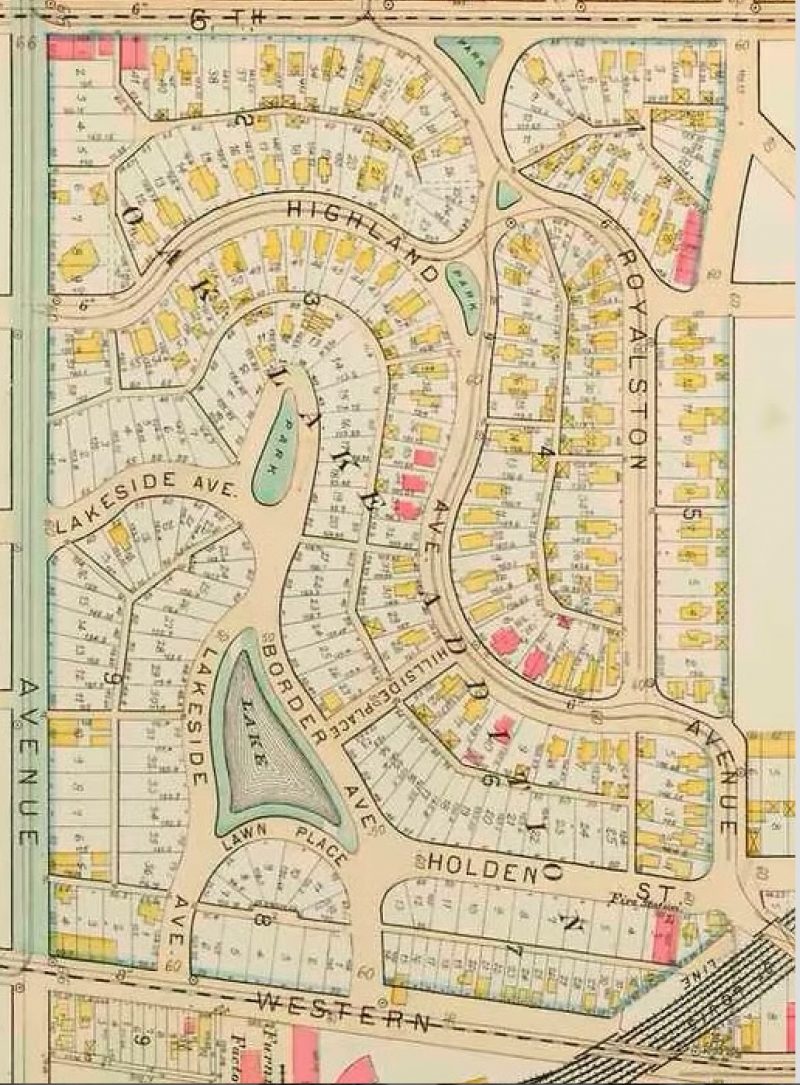
Another forgotten body of water in North Minneapolis was Oak Lake. It was a very small lake in the middle of an upper-class area of housing that was platted back in 1873. It was bounded by 6th Ave N (now Olson Highway) to the north, Western Ave (now Glenwood Ave) to the south, Lyndale to the west, and Royalton Ave and a railroad yard to the east. In the early 1900s the little lake was becoming stagnant, and some of the well-to-do families were moving to the neighborhoods surrounding Loring Park and its nicer little lake. Oak Lake was filled in by the park board and tennis courts were put in its place. In 1936, the park board gave the land to the city, and the surrounding houses were demolished to build the Farmer’s Market.
Over the years I had heard vague stories of a pond that once sat in the area of the North High football field. The first time I saw an actual reference to it was when Barb Bistodeau (former Camden News Flagpole columnist) sent me her mother’s 1916 North High Polaris yearbook; in it I saw this quote by John Greer, North’s first principal, “There was nothing in sight but woods, squirrels and a number of cows drinking leisurely from the quiet waters of Todd’s pond [our current athletic field].” I then found references to Todd’s Pond in park board minutes in the 1890s about it being used as a place to skate in the winter and even had a warming house. The pond, which worked well for skating in the winter, often flooded its banks other times of the year much to the annoyance of nearby home owners. In 1915 the pond was filled in to become the athletic field for North High but it was still often muddy and had standing water. In 1937 improvements were made to the field, including better drainage, and it was named Hobbs Field in honor of Waldo Hobbs who had been North’s Principal for 42 years.
Unfortunately, through all of my digging, I have been unable to find actual photos of these bodies of water. I have only found photos related to them. I’m also wondering if there are other Northside forgotten ponds.
I’d like to note that I found some information in a piece by Josh Biber titled “The Lost Lakes of Minneapolis” It’s worth checking out because it also has information about forgotten lakes and ponds from other parts of the city: minnesotahistory.org/post/the-lost-lakes-of-minneapolis.