

The days are getting shorter and colder, and I am beginning to think we might actually be headed towards winter. Regardless of the weather, I know we are headed for the holidays. The Halloween skeletons were barely down before the Christmas lights and trees were up. The Thanksgiving holiday will probably be passed by the time you read this issue of the Camden News, so we will lean into the winter holidays — it is amazing how many plants are associated with them.
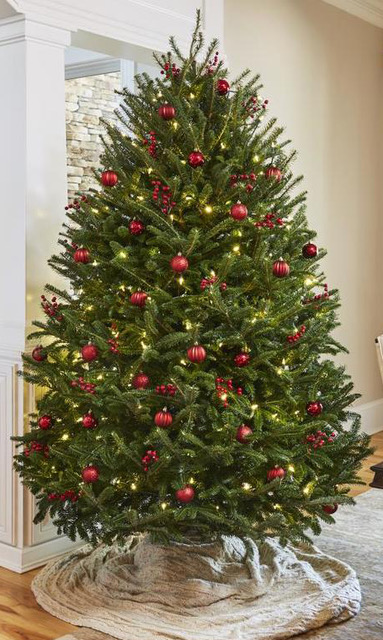
Long time readers of this paper and particularly this column, will know of my affinity for a live Christmas tree. For those of you have not heard from me before (and a refresher for those who have) I am getting back up on my soapbox about choosing a live Christmas tree this year, if a tree is part of how you celebrate the holidays. Choosing a live tree over an artificial one is helping both the environment and the economy.
Today most Christmas trees are grown on tree farms, an industry that employs more than 100,000 people. 2-3 seedlings are planted for each tree harvested and during the 7-10 years that it will take them to reach maturity they will provide a habitat for birds and wildlife, and remove dust, pollen and CO₂ from the air, while each acre of trees will provide the daily oxygen requirement for 18 people. After the holidays you can prop your tree up in the yard where it can serve as haven for wildlife. After they are the trees are picked up by the City they will be chipped and used as wood mulch for our gardens and newly planted trees. If it is the cost of a live tree that concerns you consider that an artificial tree will only last an average of six years and then spend the next 100 years in the landfill. If you are due for a new tree this year consider going the environmentally friendly route, reducing your carbon footprint and supporting a large industry in Minnesota.
Another plant associated with the winter holidays is mistletoe. I find the story of mistletoe and how kissing under it became part of the holiday tradition very fascinating. The Anglo Saxon word “misle” means dungand “tan” meant twig; thus mistletoe meant “dung on a twig,” not exactly the romantic association it has today. Mistletoe is a parasitic plant, meaning it needs a host plant on which to live and that is usually a deciduous tree. It is also evergreen and because of this it is most noticeable in winter after the leaves have fallen off the host. This “lifestyle” maybe why mistletoe is associated with ancient beliefs and myths, and how it came to be known as the “kissing plant.”
The ancient belief was that mistletoe sprang to life from bird droppings in the treetop (thus the name “dung on a twig”). Legend has it that the ancient Druids of Old Europe considered mistletoe to be sacred, possibly because the evergreen plant seemed to magically appear in the trees in the winter after all the other traces of green had disappeared. The Druids were required to cut the plant from oak trees with a gold knife, the mistletoe had to fall on a white sheet and be carried away by virgins. Because of its reputation as an aphrodisiac and as an aid to fertility, mistletoe was used in wedding ceremonies, which may have led to the practice of kissing beneath it. Kissing under the mistletoe is a relatively new Christmas tradition however, as years ago this was practiced in England on New Year’s. The practice of kissing under the mistletoe at Christmas may actually be of Scandinavian origin. According to this custom, any two people meeting under mistletoe are obligated to kiss. In his story, Christmas Eve, Washington Irving states, “The mistletoe is still hung up in farmhouses and kitchens at Christmas and the young men have the privilege of kissing the young girls beneath it, plucking each time a berry from the bush. When the berries are all plucked the privilege ceases.”
Another holiday plant is the holly. There are over 400 species of holly, which grow as hedges or trees ranging from 18 to 50 inches high and can be either deciduous or evergreen. However, the holly which is considered the traditional Christmas holly is the American Holly (Ilex Opaca), a broadleaf evergreen, but it is unlikely that you will see an American Holly growing anywhere near here, as it is hardy in only zones 5-9. Sprigs of American Holly brought into our homes for the holidays have spiny leaves and bright red berries, but beware of the berries around children and pets, as they are toxic.
Like holly there are hundreds of species of ivy, but in this case there is not one species that is associated with the Christmas traditions. Boston Ivy (Parthenocissus tricuspidata) is hardy to zone 4 and is typical of the type of ivy we might connect with the holidays. English ivy is another and is often grown as a houseplant in our climate.
Holly, ivy, poinsettias, all other plants associated with the winter holidays make us realize that the plants fill our homes and lives all year round — that there is plenty of green to sustain us until the garden emerges from under the snow next spring. Enjoy your green in the winter that will soon sweep upon us.