

written by Sarah Dugan, Kroening Nature Center Naturalist
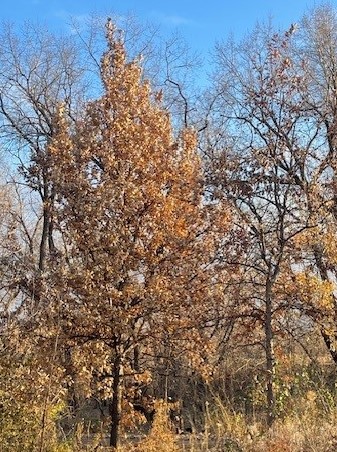
After a particularly beautiful autumn for our local trees most of the leaves have fallen, with a few exceptions. Evergreen trees, like pines and cedars, will stay green all winter, but you may have noticed others still holding their brown, dry leaves even into early spring. So how do the trees know when to drop their leaves? What causes the variation? And why do trees lose their leaves anyway?
All plants, trees included, lose water to the air, mainly through their leaves. When winter comes and water freezes it becomes much harder to access. Different strategies have evolved to survive this harsh environment. Evergreens have waxy, often narrow leaves that look like needles or scales. These leaves lose much less water than other species. Instead of an annual leaf drop, they continuously lose their oldest needles as they are shaded out by longer or higher branches on the tree. In Minnesota, our native evergreens are all conifers, and most conifers are evergreen. Tamaracks are an exception, turning yellow and dropping their needles each fall, usually in October and November.
In contrast, deciduous trees evolved a mechanism to drop their leaves each year as they go into a dormant (non-growing) period for the winter. In dormancy they conserve resources for growing the following year and are protected from dehydration and frost damage. One of the first autumnal changes that occurs in deciduous trees is the increasing breakdown of chlorophyll, the light-harvesting compound that gives leaves their green color. The nutrients in the chlorophyll are then reabsorbed into the tree to be used for the next year’s growth. The yellows and oranges we see in the fall are the result of other chemicals, similar to those that make carrots orange, remaining in the leaves.
As the chlorophyll decreases, another process, called abscission, begins. At the connection between each leaf and its twig on a deciduous tree is a protective layer similar to bark forms. Eventually, on the leaf side of this layer, chemicals that break down plant cells are released, weakening the connection and allowing the leaf to fall off.
So what tells a tree it’s time to start changing and dropping leaves? And why do some trees hold on to their leaves much longer than others? The triggers are interconnected and complex, but include signals of decreased daylight, colder nights, and sometimes other environmental stressors such as drought or disease. Just like leaves emerging in the spring, different species of trees respond to these signals at different times. The yellow leaves of aspen and poplar trees can be seen turning as early as late August and maples often peak in October.
Which brings us to the trees, particularly young oaks, that still have some of their dried leaves in January. It turns out that many of these leaves just never form the separation later that allows leaves to drop off the tree. It’s not until the buds expand in the spring that they push the old leaves off. The reason, if there is one, is not understood, but possible benefits include keeping deer from getting past their leaves to the tasty buds, protecting the buds from harsh, drying winds.
Come to the nature center this month to check out our trees and these upcoming programs:
Nature Tots: Canine Club · Saturday, December 6, 10:30-11:30 a.m. | Free | Ages 2-6 with adult | Activity #21687 |Discover what life is like when you’re a member of the canine club. Find out how fox families and coyote clans live in our parks and neighborhoods as urban predators through touch, and see activities and imaginative play.
Homeschool Day: Survival Skills · Thursday, December 11, 1-2:30 p.m. | free for residents | Ages 5-11 | Activity # 18889 | Learn how to stay warm outdoors by practicing survival skills. We’ll talk about outdoor safety, build a shelter out of natural materials to protect against the elements, and warm-up by building a fire.
Drop-in Nature: Tracks and Scat · Saturday, December 13, 10:30 a.m.-2:30 p.m. | Free | All Ages | Activity #21691| Come by the nature center to participate in a variety of activities all about tracks and scat left behind by the animal residents of the park. Find out who’s been eating what and try a variety of activities to hone your skills as a nature detective.
Nature Art: Recycled Wrapping · Saturday, December 20, 1:30-2:30 p.m. | Free | All Ages | Activity #21695| Learn new ways to wrap your gifts this season! Reuse and decorate a variety of materials to make beautiful wrapping, containers and gift tags for the holidays.
Winter Solstice Celebration · Saturday December 20, 6-9 p.m.| Free | All Ages | Activity #18939| Rejoice the coming of longer days! Take a walk along a glowing trail, enjoy the warmth of a bonfire, and make your own luminary to bring home.